The Shar-Pei is believed to date back to the Han dynasty (around 200 BC to 200 AD) in the southern Chinese province of Guangdong. Statues bearing a strong resemblance to the Shar-Pei have been found from this period, and a 13th-century Chinese manuscript describes a wrinkled dog with very similar characteristics.
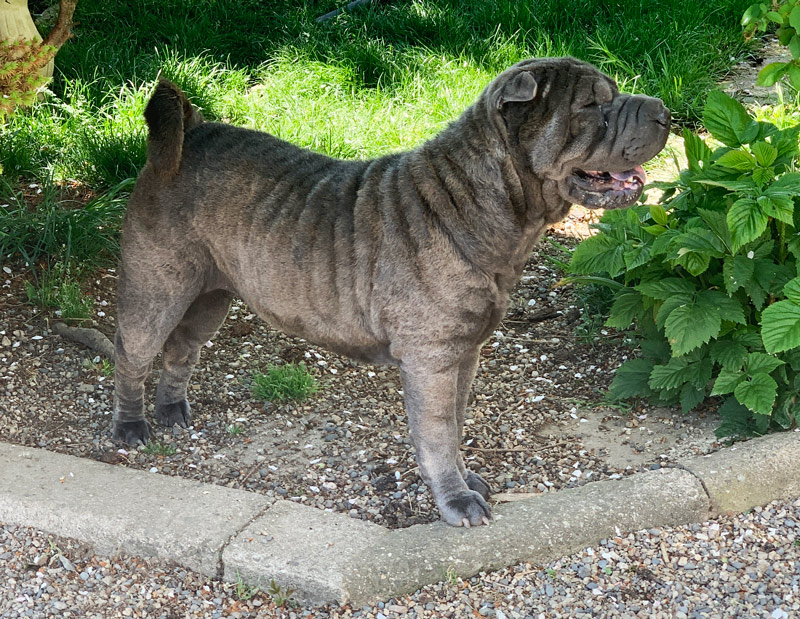
A Distinctive Appearance
The name Shar-Pei means « sand skin », referring to the coarse, almost prickly texture of its coat, a defining trait of the breed.
Originally used for hunting and guarding, the Shar-Pei was later used in fighting, a role for which its body was well suited: loose, elastic skin allowing it to twist around if bitten, a bristly coat, and a tail that was difficult to grab. This earned it the nickname « Chinese Fighting Dog ». Breeders of the time emphasised these physical traits to give the dogs an advantage in the ring, although the breed was never known for having a naturally aggressive temperament.
A Breed on the Brink
In the 19th century, new fighting breeds such as Bulldogs and Mastiffs appeared, far more powerful than the Shar-Pei, which quickly fell out of favour. Numbers declined sharply, and a tax introduced on fighting dogs around 1950 pushed the breed even closer to extinction.
By the late 1960s, very few Shar-Pei remained in China. Local enthusiasts, including Mr. Law and Mr. Chung, reached out to breeders in the United States, urging them to take in the dozen or so Shar-Pei still left in order to save the breed. A magazine article sparked huge public interest, and the breed gained worldwide popularity. The first Shar-Pei arrived in Germany in 1979, followed shortly after by France.