The Shar-Pei is recognised by the Fédération Cynologique Internationale under Standard No. 309, within Group 2 (Pinscher and Schnauzer, Molossoid and Swiss Mountain and Cattledogs), Section 2.1, Molossoid breeds. Originally from China, the breed was first used for hunting and guarding.
Below is a short summary of the main characteristics described in the official standard. For the full, legally authoritative text, please refer to the FCI or your national kennel club.
Size
44–51 cm at the withers
Coat
Short, harsh, bristly, no undercoat
Temperament
Calm, independent and loyal
General Appearance
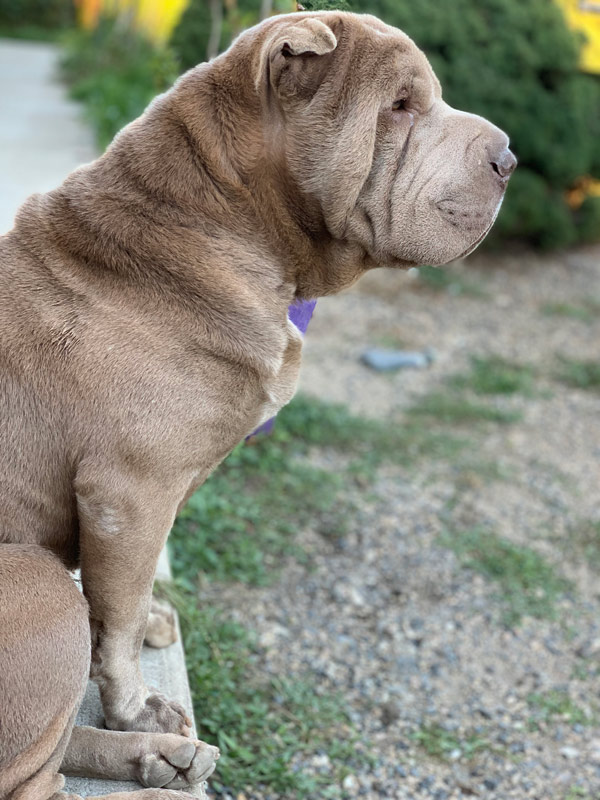
A medium-sized, active and compact dog with a short back, fitting within a square outline. Its wrinkled skull, the folds at the withers, small ears and a muzzle reminiscent of a hippopotamus give the Shar-Pei its unmistakable look. Males are noticeably larger and more powerful than females.
Temperament
Calm, independent and loyal, the Shar-Pei is deeply affectionate towards its family.
Head and Muzzle
The head is proportionately large, with wrinkles on the forehead and cheeks extending down to form the dewlap. The muzzle is broad from base to tip, with thick lips, and the tongue, palate, gums and lips are ideally bluish-black (lavender in dilute-coloured dogs). Eyes are dark, almond-shaped, and must never be obstructed by skin, folds or hair. Ears are very small, thick, triangular and carried close to the skull.
Body and Tail
In adult dogs, loose skin folds on the body are undesirable except at the withers and the base of the tail. The tail is thick and round at the root, tapering to a fine point, and is set and carried high, often curled over the back, a hallmark feature of the breed.
Coat and Colour
The coat is short, harsh and bristly, with no undercoat, ranging from about 1 to 2.5 cm in length and never trimmed. Any solid colour is accepted, except white; a slightly shaded tone along the back and ears is tolerated.
Size
Height at the withers: 44–51 cm (approximately 17.5–20 inches).
Faults
Any deviation from the standard is considered a fault, assessed according to its severity. Serious faults include an incorrect bite, a pinched muzzle, large ears, a low-set tail or an overlong coat. Dogs that are aggressive or overly fearful, or that show obvious physical or behavioural abnormalities, are disqualified, as are dogs with excessive body wrinkling, a non-solid coat colour, or a docked or absent tail.
Only healthy dogs, typical of the breed in both structure and temperament, should ever be used for breeding.